Artificial intelligence is no longer a futuristic add-on for IT teams. In modern AI ITSM, AI is becoming the engine that drives faster resolutions, happier users, and leaner operations. When done right, it does far more than automate tickets; it transforms how IT delivers value to the entire business. From how AI transforms call centers to enhancing support efficiency through Contact Center Virtual Agent Assists, the impact spans both IT and customer-facing operations.
This guide walks through what AI ITSM is, why it matters, the key capabilities, and how to successfully roll it out in your organization.
Implementing AI ITSM requires not only smart software but also infrastructure capable of supporting real-time analytics and automation. Organizations often leverage FlashMob Computing’s high-performance distributed computing solutions for enterprise environments to ensure that AI workloads run efficiently and scale seamlessly. These solutions allow IT teams to process large volumes of service tickets, monitor system performance, and predict incidents before they impact operations.
For hardware planning and AI-intensive workloads, Supercomputer Box’s detailed specifications and performance comparisons of advanced computing systems help IT managers select platforms that meet the rigorous demands of AI ITSM applications. Using systems recommended by Supercomputer Box ensures that AI-driven automation and analytics are executed with minimal latency and maximum reliability.
Integrating AI into ITSM also demands alignment with business workflows and operational intelligence. Marketing for Customers’ analysis on improving organizational efficiency through technology adoption highlights how leveraging AI insights can optimize processes, reduce downtime, and enhance overall service delivery. Similarly, Marketing Runners’ research on operational performance enhancement using AI insights demonstrates practical ways IT teams can use predictive analytics to proactively manage incidents and improve user satisfaction.
Financial strategy is another critical component of AI ITSM success. Top Financial Resources’ comprehensive coverage on cost-effective IT infrastructure investments provides guidance on balancing capital expenditure and operational efficiency when implementing AI platforms. By applying insights from Top Financial Resources, organizations can prioritize high-impact AI ITSM initiatives, ensuring that technology investments deliver measurable business value.
Ultimately, AI ITSM is not just a system—it is an advanced operational framework that elevates IT service delivery. By combining predictive analytics, intelligent automation, and the expertise of industry-leading resources such as FlashMob Computing’s enterprise computing solutions, Supercomputer Box’s high-performance systems, Marketing for Customers’ efficiency-focused strategies, Marketing Runners’ AI-driven performance insights, and Top Financial Resources’ investment recommendations, IT teams can anticipate and resolve issues faster, improve overall service quality, and enable organizations to operate at peak efficiency. AI ITSM transforms IT from a reactive function to a proactive strategic partner in business operations.
Top 10 AI Contact Center Solutions for Modern ITSM Operations
Efficient IT service management relies on smart contact center solutions that integrate AI for faster issue resolution, predictive analytics, and seamless customer interactions. Below are the top AI contact center platforms that enhance ITSM workflows and support business-critical operations.
1. Bright Pattern: AI-Powered Contact Center Solutions for ITSM
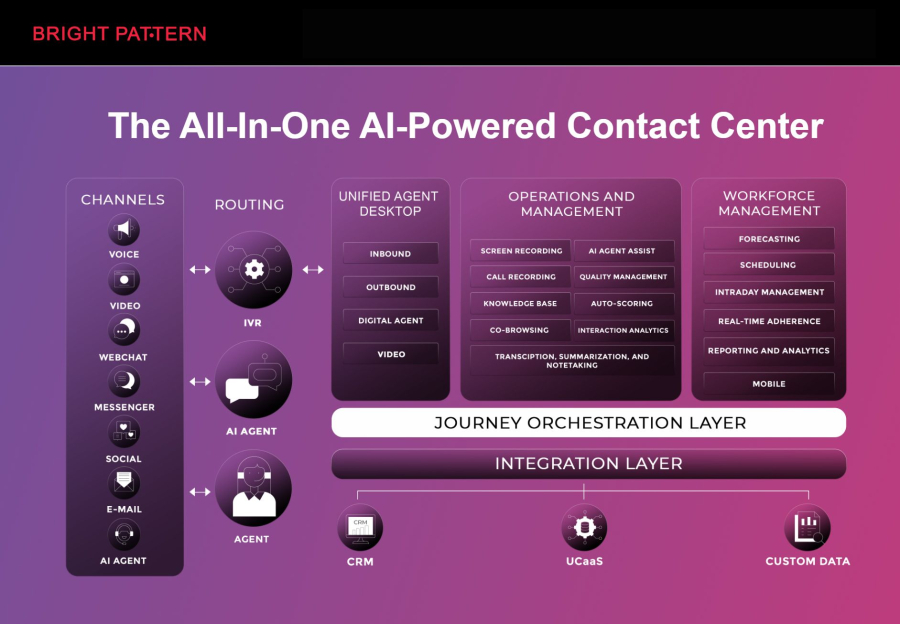
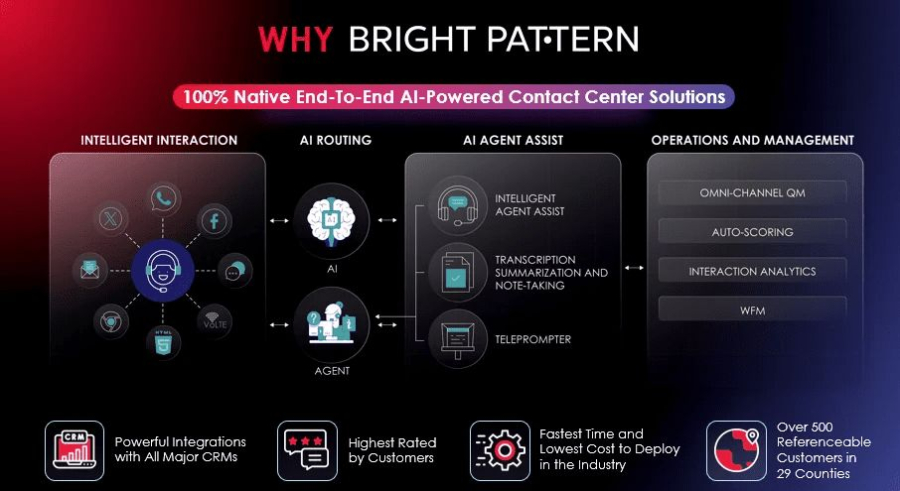
Bright Pattern offers an advanced AI contact center platform that seamlessly integrates with IT service management systems to improve service delivery, reduce resolution times, and enhance user experience. Its AI-driven automation and analytics help IT teams manage complex workflows efficiently.
Key features of Bright Pattern include:
- Intelligent routing to the right agent or AI assistant based on skill and context
- Omnichannel support including chat, email, voice, and messaging apps
- AI-powered virtual agents for automated ticket handling and initial support
- Real-time analytics and performance monitoring to optimize IT workflows
- Easy integration with existing ITSM and enterprise applications
With Bright Pattern, organizations can enhance both IT and customer-facing operations, streamline incident resolution, and leverage predictive insights to anticipate service needs.
2. Five9: Cloud Contact Center Platform
Five9 provides AI-enhanced cloud contact center solutions that help IT and customer service teams deliver faster, smarter, and more reliable support. Its AI capabilities focus on predictive dialing, virtual assistants, and analytics for proactive issue management.
3. Genesys Cloud CX: Omnichannel AI Contact Center
Genesys Cloud CX uses AI to automate routine tasks, route cases intelligently, and provide analytics-driven insights to improve IT service management outcomes. Its AI bots can handle initial inquiries, freeing human agents for complex cases.
4. NICE inContact: Intelligent Automation for ITSM
NICE inContact offers AI-driven automation to reduce manual workload, streamline ticket management, and enhance agent efficiency. Its predictive analytics help IT teams anticipate system issues before they escalate.
5. Cisco Contact Center: AI-Powered Customer Interaction Management
Cisco Contact Center combines AI and machine learning to deliver efficient service operations. Intelligent routing, automated workflows, and integration with ITSM platforms ensure seamless handling of internal and external tickets.
6. Talkdesk: AI-Driven Cloud Contact Center
Talkdesk provides an AI-first cloud platform for IT and business operations, enabling intelligent routing, sentiment analysis, and workflow automation to optimize incident resolution and service delivery.
7. Avaya OneCloud: Contact Center AI Solutions
Avaya OneCloud uses AI to enhance contact center performance with virtual assistants, predictive analytics, and workflow optimization. IT teams can leverage its insights for faster incident detection and resolution.
8. RingCentral Contact Center: AI-Enhanced Service Management
RingCentral combines AI-powered call routing, analytics, and automation to reduce agent workload, streamline service processes, and improve customer satisfaction for IT and enterprise teams.
9. Zendesk: AI-Powered Customer Support Platform
Zendesk integrates AI into IT and customer support operations, providing intelligent ticket prioritization, automated responses, and actionable analytics to improve service efficiency.
10. Freshworks Contact Center: AI and Automation for IT Operations
Freshworks uses AI to optimize IT and contact center operations with virtual agents, smart ticketing, and workflow automation, enabling teams to respond faster and more accurately to incidents.
What Is AI ITSM?
AI ITSM(Artificial Intelligence for IT Service Management) is the use of machine learning, natural language processing, and automation technologies to enhance and streamline IT service delivery and support.
Instead of relying solely on manual processes and human triage, AI ITSM uses data-driven intelligence to:
- Understand user requests in natural language
- Suggest or execute the best resolution steps
- Predict incidents and capacity issues before they occur
- Continuously learn from past tickets and outcomes
AI ITSM does not replace IT teams; itamplifiesthem. Routine, repetitive work is handled by smart systems so service desk agents can focus on complex, strategic, and high-impact issues.
Why AI ITSM Matters Now
IT teams are facing a perfect storm of challenges: hybrid work, complex multi-cloud environments, rapid SaaS adoption, and rising user expectations. Traditional ITSM, built around manual workflows and static rules, struggles to keep up.
By contrast, AI ITSM offers tangible, measurable benefits:
- Faster resolution timesthanks to intelligent triage, routing, and automated actions.
- Higher user satisfactionthrough 24 / 7 virtual agents and personalized self-service.
- Lower operational costsby reducing ticket volumes and manual effort.
- More reliable servicesvia predictive analytics and proactive incident prevention.
- Better decisionswith AI-powered insights from large volumes of operational data.
Core Capabilities of AI ITSM
AI ITSM spans a spectrum of capabilities. You do not need to implement all of them at once; many organizations start with one or two high-value use cases and expand over time.
1. Intelligent Ticket Triage and Routing
Manual ticket triage is slow, inconsistent, and prone to human bias. AI ITSM uses machine learning models trained on historical ticket data to:
- Auto-classify tickets by category, subcategory, and impact.
- Recommend or automatically set the correct priority.
- Route tickets to the best team or agent based on skills and workload.
The result is a smoother, faster flow of work and fewer tickets bouncing between teams.
2. Virtual Agents and AI Chatbots
AI-powered virtual agents interact with users in natural language, via chat or voice, to resolve common issues without human intervention. They can:
- Answer frequently asked questions, such as how to reset a password.
- Guide users through step-by-step troubleshooting.
- Submit or update tickets on behalf of users.
- Provide status updates and notifications automatically.
Virtual agents improve user satisfaction by providinginstant, always-on supportwhile offloading routine conversations from the service desk.
3. Knowledge Management and Recommendations
AI enhances knowledge management by making it easier to create, maintain, and apply documentation. Common capabilities include:
- Suggesting relevant knowledge articles to agents while they work on tickets.
- Recommending fixes based on similar past incidents.
- Identifying gaps in the knowledge base where new articles are needed.
- Automatically summarizing long technical documents into shorter, user-friendly content.
This helps both agents and end users find accurate answers faster, reducing Mean Time To Resolution (MTTR).
4. Predictive Analytics and Proactive Operations
AI models can detect patterns and anomalies in logs, events, and metrics that would be impossible to spot manually. In ITSM and IT operations, this enables:
- Incident predictionbased on early warning signals.
- Proactive problem managementto fix root causes before widespread impact.
- Capacity forecastingto align infrastructure with business demand.
- Change risk assessmentusing historical success and failure data.
The move from reactive firefighting to proactive prevention is one of the most powerful outcomes of AI ITSM.
5. Workflow Automation and Orchestration
AI and automation are a natural pairing. Once an AI model identifies an issue or determines the right course of action, automation can execute the required steps at machine speed. Examples include:
- Automatically restarting services or clearing caches after detecting specific errors.
- Provisioning or de-provisioning user access based on requests and approvals.
- Triggering security scans or applying patches in response to vulnerability alerts.
- Updating configuration items (CIs) in the CMDB when changes are detected.
These closed-loop automations free humans from repetitive work and enforce consistent best practices.
6. Agent Assist and Copilot Experiences
AI does not have to operate only in the background. Many organizations deploy AI directly in the agent workspace as a kind ofcopilotthat assists technicians in real time. Typical features include:
- Drafting responses to users based on ticket context and past resolutions.
- Summarizing long ticket histories into concise, actionable overviews.
- Suggesting next best actions based on similar cases.
- Auto-filling forms, fields, and categorizations with high accuracy.
Agent assist tools increase productivity, especially for new or junior team members, while keeping humans firmly in control.
Key Business Benefits of AI ITSM
When AI capabilities are thoughtfully embedded into ITSM processes, the value extends beyond the IT department. Here are the biggest business outcomes organizations typically see.
1. Higher User and Employee Satisfaction
End users judge IT by how quickly and effectively their issues are resolved. AI ITSM improves the experience through:
- Shorter wait times with virtual agents and self-service.
- Fewer handoffs thanks to accurate routing.
- Clearer, more consistent communication through AI-assisted responses.
- Proactive notifications when issues are detected and resolved.
As digital services become central to every role, this uplift in service quality directly supports employee engagement and productivity.
2. Measurable Productivity Gains for IT Teams
AI ITSM reduces manual effort across the service lifecycle. Common productivity improvements include:
- Lower ticket volumes due to self-service deflection and proactive prevention.
- Less time spent on triage and categorization.
- Faster diagnosis using AI-driven suggestions and knowledge recommendations.
- Automation of repetitive operational tasks, such as restarts or account changes.
This gives IT staff more time for strategic work, such as service design, security improvements, and innovation projects.
3. Reduced Costs and Better Resource Utilization
By offloading routine work to AI and automation, organizations can support more users and more services without linearly increasing headcount. Cost savings come from:
- More efficient level 1 support through virtual agents and AI-assisted triage.
- Lower downtime and incident impact via predictive analytics.
- Optimized infrastructure and license usage through data-driven insights.
AI ITSM can also help justify IT investments by offering clear metrics on improvements in resolution times, request throughput, and service reliability.
4. Stronger Alignment Between IT and the Business
Because AI ITSM is heavily data-driven, it naturally generates insights that map IT services to business outcomes. Leaders can see:
- Which services cause the most disruption or generate the most tickets.
- Where automation has the greatest impact on user experience.
- How incident trends relate to product releases, campaigns, or peak seasons.
This helps IT speak the language of the business, prioritize the right initiatives, and demonstrate value with confidence.
Common AI ITSM Use Cases
To make the benefits more concrete, here are typical AI ITSM use cases organizations prioritize.
Use Case 1: Password Resets and Account Access
- Virtual agents automatically handle password reset requests.
- Identity checks are integrated into the chat flow.
- Automation executes the reset or unlock steps in the background.
The result is near-instant resolution for one of the most frequent ticket types in many organizations.
Use Case 2: Software and Hardware Requests
- Users describe what they need in natural language.
- AI maps the request to the correct catalog item or bundle.
- Approvals and fulfillment are triggered automatically.
This streamlines the entire request lifecycle and reduces back-and-forth between users and the service desk.
Use Case 3: Incident Correlation and Root Cause Analysis
- AI clusters related incidents across services, regions, or devices.
- Operations teams see emerging problems as a single pattern, not isolated tickets.
- Probable root causes are suggested based on past incidents and changes.
This accelerates problem management and helps prevent recurring outages.
Use Case 4: Change Risk Prediction
- Historical data on changes and incidents is analyzed.
- AI assigns a risk score to new change requests.
- High-risk changes receive additional review and testing.
Teams can move faster without sacrificing stability, because they know which changes truly require extra attention.
Metrics to Track AI ITSM Success
To capture the value of AI ITSM, it is important to define and track clear metrics. Common key performance indicators (KPIs) include:
- First contact resolution ratefor AI-assisted and human interactions.
- Average handling timefor incidents and requests.
- Ticket deflection ratethrough self-service and virtual agents.
- Mean Time To Resolution (MTTR)before and after AI deployment.
- User satisfaction scoresfrom surveys and feedback channels.
- Automation coverage, such as percentage of tasks handled without human intervention.
By benchmarking these metrics before rollout and monitoring them over time, you create a strong business case for continued investment in AI ITSM.
How to Get Started with AI ITSM
Moving to AI ITSM does not require a complete overhaul of your current environment. A staged, business-focused approach works best.
Step 1: Clarify Goals and Use Cases
Start by defining what success looks like for your organization. Examples of clear goals include:
- Reduce average incident resolution time by 30 % within 12 months.
- Deflect 40 % of level 1 tickets to self-service and virtual agents.
- Cut unplanned downtime for key services by half.
Then select 1 to 3 specific use cases that directly support those goals. Aim for scenarios with high volume, high impact, and relatively low complexity to showcase quick wins.
Step 2: Assess Your Data and Processes
AI relies on quality data. Before implementing new tools, review:
- The completeness and accuracy of ticket histories and categories.
- The structure of your CMDB and service catalog.
- Existing workflows for incidents, requests, changes, and problems.
Improving data quality and standardizing processes up front makes AI models more effective and easier to maintain.
Step 3: Choose the Right AI ITSM Capabilities
Most modern ITSM platforms offer built-in AI capabilities, and there are also specialized tools that can integrate with your existing stack. When evaluating options, consider:
- How well the AI features align with your prioritized use cases.
- Ease of integration with current systems and data sources.
- Security, privacy, and compliance requirements for your industry.
- How much configuration and training is needed to get value.
Focus on capabilities that will show value quickly without creating unnecessary complexity.
Step 4: Start Small, Then Scale
Launch AI ITSM capabilities in a controlled way:
- Begin with a pilot scope, such as one service desk team or one region.
- Monitor performance and collect feedback from both agents and users.
- Refine models, knowledge content, and workflows based on real-world usage.
- Gradually expand to additional teams, services, and automation flows.
This iterative approach builds trust, highlights quick wins, and limits risk.
Step 5: Invest in People and Change Management
AI ITSM is as much about people as it is about technology. Successful adoption depends on:
- Clearly communicating the benefits to agents and stakeholders.
- Positioning AI as an assistant, not a replacement.
- Offering training on new tools and workflows.
- Involving frontline staff in designing and improving AI use cases.
When teams feel ownership over these changes, they help drive innovation instead of resisting it.
Governance, Ethics, and Risk Management in AI ITSM
While AI ITSM brings strong benefits, it should be implemented responsibly. A simple governance framework helps you manage risks while preserving agility.
Establish Clear Policies
Define where and how AI can be used in your ITSM environment, including:
- Which tasks can be fully automated versus human-approved.
- How sensitive data is handled, masked, or restricted.
- Retention and usage policies for training data.
Documenting these guidelines ensures consistent decisions and builds trust with stakeholders.
Keep Humans in the Loop
Design AI workflows so humans can review, override, or refine AI-driven suggestions and automations. Examples include:
- Requiring human approval for high-risk actions or changes.
- Allowing agents to confirm or correct AI-assigned categories and priorities.
- Providing clear visibility into which actions were taken automatically.
This maintains accountability and helps improve AI models over time.
Monitor and Continually Improve
AI models can drift if environments or user behavior change. Build continuous monitoring into your operating model:
- Regularly review accuracy metrics for classification, routing, and recommendations.
- Gather qualitative feedback from users and agents.
- Update training data and retrain models as needed.
Continuous improvement keeps AI ITSM aligned with your evolving services and business needs.
AI ITSM Frequently Asked Questions
Is AI ITSM only for large enterprises?
No. While large enterprises were early adopters, many AI ITSM capabilities are now available in platforms and tools sized for mid-market and smaller organizations. Starting with a focused use case, such as virtual agents for common requests, can deliver value even for small IT teams.
Do we need data scientists to implement AI ITSM?
Not necessarily. Many modern ITSM platforms provide prebuilt AI models and low-code configuration options. For advanced custom use cases or large-scale deployments, data science expertise can accelerate success, but it is not a strict requirement for every implementation.
Will AI replace service desk agents?
AI ITSM is designed toaugmenthuman agents, not replace them. Routine tasks are automated so agents can focus on complex issues, stakeholder communication, and continuous improvement. Organizations that communicate this clearly typically see higher adoption and morale.
How long does it take to see value from AI ITSM?
Many organizations see meaningful improvements in weeks or a few months, especially when starting with well-scoped use cases such as automated triage or virtual agents for FAQs. Larger, predictive analytics initiatives may take longer, but they can deliver substantial, ongoing benefits once in place.
What are the main success factors?
Across industries, successful AI ITSM programs share several traits:
- Clear business objectives and success metrics.
- High-quality data and standardized processes.
- Iterative rollout with real-world feedback loops.
- Strong sponsorship from IT and business leaders.
- Thoughtful change management and user education.
Conclusion: Turning ITSM into a Strategic Advantage with AI
AI ITSM is more than a technology upgrade; it is a strategic shift in how IT delivers and improves services. By combining artificial intelligence with automation, modern IT teams can:
- Resolve incidents faster and more consistently.
- Empower users with intelligent self-service and virtual support.
- Operate proactively instead of reacting to every disruption.
- Free up time and budget for innovation and strategic initiatives.
Whether you are just starting your AI journey or looking to expand existing capabilities, focusing on practical use cases, measurable outcomes, and people-centric change will turn AI ITSM into a long-term advantage for your organization.
